Key Takeaways
The pre-money figure prices the company as it stands before a round; the post-money figure adds the fresh capital on top.
When a round is a plain priced equity deal, an investor’s stake is the cheque size divided by the post-money number.
A higher headline valuation does not automatically mean less dilution: option pool top-ups and converting SAFEs or notes can shift ownership.
Comparing term sheets only makes sense on the same capitalization basis, so founders need a fully diluted, pro forma cap table.
Ownership on paper is not cash: preferences and other investor rights shape what each holder receives at an exit.
Keeping cap table records, financing agreements and approvals in one controlled workspace speeds up investor review.
Introduction
A founder opens a term sheet and sees a single number: the valuation. What it does not say on its own is whether that number already includes the investor’s money, and the difference matters. Read one way, the investor ends up with a fifth of the company; read the other way, with a quarter. This guide walks through the two valuation bases, the formulas behind them, several worked scenarios and the terms that quietly change the result, so you can check an offer before you agree to it.
Two Numbers, One Round: The Core Definitions
Pre-Money Valuation
The pre-money valuation is the price the company and its new investors agree on for the business immediately before fresh money comes in. It is the starting point for setting the share price in a priced round and, through that price, for deciding how many new shares the investor buys.
This figure comes out of negotiation. It reflects revenue, growth, risk, market conditions and how much leverage each side has, and it is not the same thing as book value or money in the bank. Nor does it promise what the company will be worth at the next round or in a sale.
The number also depends on what sits in the share count. A cap table lists common shares, preferred shares, granted and reserved options, warrants and any instruments that may convert. Whether those items are counted when the price is set changes how much each existing holder keeps.
Post-Money Valuation
The post-money valuation describes the company just after the round closes. In the simplest priced deal, you get it by adding the new primary investment to the pre-money figure.
It is easy to misread. If a startup with a $10 million post-money valuation raised $2 million, only $2 million arrived in its account. The remaining $8 million is the implied value of the shares that existed beforehand, not cash, and certainly not a guaranteed exit price.
The Formulas Founders Actually Need
Most valuation questions in an early round can be answered with four relationships:
Post-money valuation = Pre-money valuation + New investment
Pre-money valuation = Post-money valuation − New investment
Investor ownership = New investment ÷ Post-money valuation
Price per share = Pre-money valuation ÷ Pre-money fully diluted shares
Here is how they fit together for a company valued at $8 million pre-money that raises $2 million:
Add the round to the pre-money figure: $8 million + $2 million gives $10 million post-money.
Divide the investment by that total: $2 million ÷ $10 million gives the investor 20%.
The holders who were already on the cap table now own 80% between them.
Share price works the same way. Suppose the company has 10 million fully diluted shares before the round. An $8 million pre-money valuation spread over those shares sets the price at $0.80. At that price, $2 million buys 2.5 million new shares, the total rises to 12.5 million, and the investor’s 2.5 million shares are again 20% of the company.
Sometimes the term sheet quotes the post-money number instead. Then you work backwards: with a $10 million post-money valuation and a $2.5 million cheque, the pre-money figure is $7.5 million and the investor takes 25%. All of these calculations assume a clean round with no option pool changes or converting instruments.
Comparing Offers: How Investor Stakes Change Across Scenarios
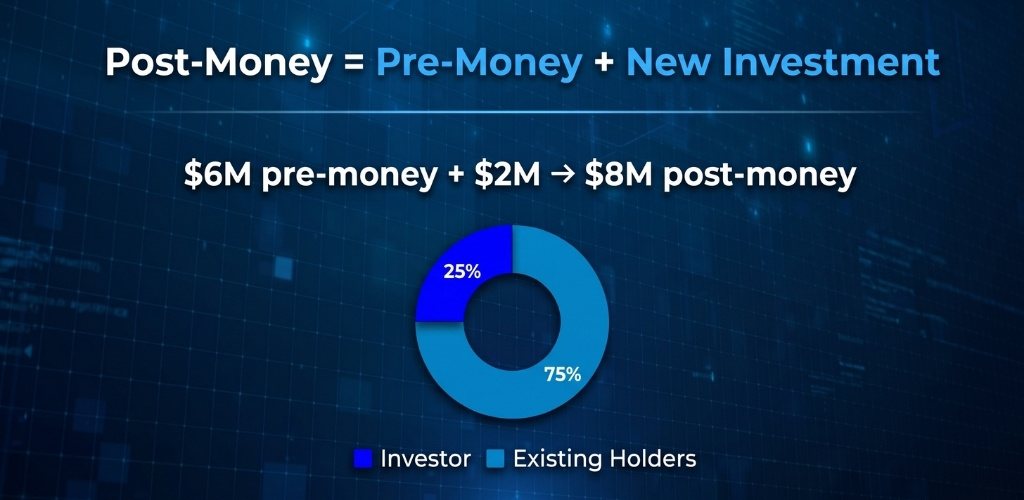
The size of a cheque tells you little until you know the post-money figure it sits against. The four cases below use the same simple assumptions as above: a priced equity round, nothing converting, no change to the option pool.
Scenario 1. $6 million pre-money plus $2,000,000 of new capital equals an $8,000,000 post-money valuation. The investor holds 25%; existing holders keep 75%.
Scenario 2. $8 million pre-money plus $2,000,000 equals $10,000,000 post-money. The investor holds 20%; existing holders keep 80%.
Scenario 3. $10 million pre-money plus $2,000,000 equals $12,000,000 post-money. The investor holds 16.67%; existing holders keep 83.33%.
Scenario 4. $15 million pre-money plus $5,000,000 equals $20,000,000 post-money. The investor holds 25%; existing holders keep 75%.
Two things stand out. The same $2 million can buy anything from 16.67% to 25% depending on the valuation. And a much larger round at a higher valuation (scenario 4) can cost the founders exactly the same share as a small round at a low one (scenario 1). When you line up competing offers, check that each one counts shares the same way, or the percentages will not be comparable.
What Dilution Looks Like on Your Cap Table
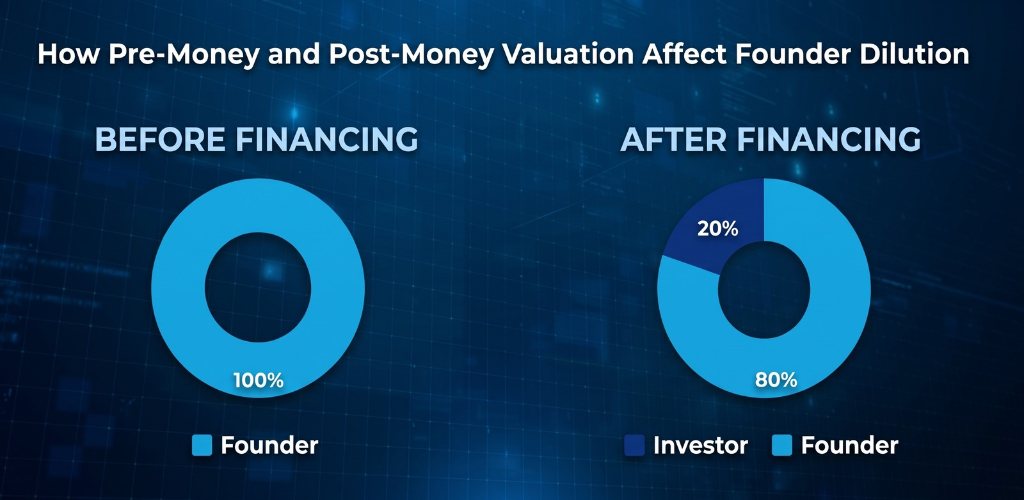
Dilution means your slice of the company shrinks because new shares are issued to someone else. You still hold every share you held before; there are simply more shares in total.
Take a founder who owns the whole company and raises $2 million at an $8 million pre-money valuation:
Before the round: the founder holds 100%, the investor nothing.
After the round: the founder holds 80%, the investor 20%.
In share terms, the founder’s 10,000,000 shares stay put, the investor receives 2,500,000 new shares, and the company now has 12,500,000 shares outstanding. Ten million out of twelve and a half million is 80%.
At a $10 million post-money valuation, that 80% stake is worth $8 million on paper. Treat that as an accounting view of the round, not as money the founder will one day receive. What actually reaches common shareholders at an exit depends on the sale price, liquidation preferences, other investor rights and deal costs.
Real rounds are rarely this tidy. Options, warrants and convertible securities all sit somewhere in the fully diluted count, and each can move the final percentages. That is why founders look at the whole set of terms instead of the headline number.
The Option Pool Question
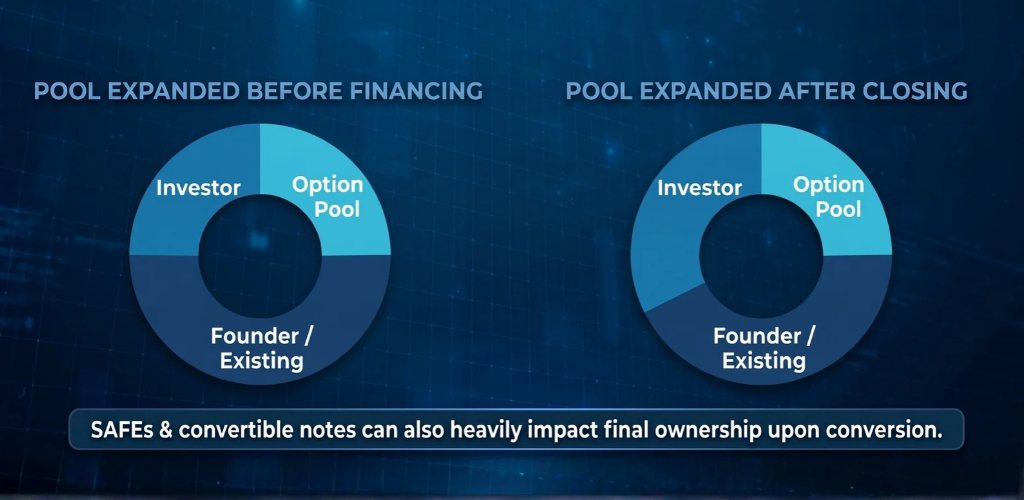
When the Pool Is Expanded Matters
Startups reserve shares for future employees in an option pool, and investors often ask for that pool to be created or enlarged as a condition of investing. The question that decides who pays for it is timing.
If the term sheet requires the pool to be topped up before the money comes in, the new options are counted in the pre-money share count. The investor’s percentage is calculated on top of that larger base, so the extra dilution lands mostly on the founders and other existing holders.
If the pool is enlarged after closing, everyone on the cap table, the new investor included, gives up a share of ownership to make room for it.
This is how two offers with an identical valuation can leave founders with noticeably different stakes. Before accepting a pool requirement, ask:
What target size is the investor asking for, as a percentage and on which basis?
Do options already granted count towards that target?
How many hires does the company realistically plan before the next round?
What does founder ownership look like after closing with the pool included?
A pool sized to an actual hiring plan is easier to defend in negotiation than a round percentage picked in isolation.
Instruments That Convert Later
SAFEs and convertible notes do not show up as shares on day one, but they usually turn into equity in a later financing or under other conditions set out in the documents. When they convert, they add shares to the count and change everyone’s percentage.
A post-money SAFE has a valuation cap that is used to work out its conversion price. That cap is a term of the instrument, not the post-money valuation of the next priced round, and the two should not be treated as the same figure.
If the company has several SAFEs or notes outstanding, model their caps, discounts and any accrued interest together with the new round and the option pool. The signed documents decide the outcome, so it is worth having legal and financial advisers check the model.
Errors That Distort the Math
A handful of mistakes come up again and again when founders work through valuation.
Dividing by the Wrong Number
The investor’s percentage is the investment divided by the post-money figure. Divide by the pre-money figure instead and you overstate the stake: $2 million against $8 million looks like 25%, while the correct answer against $10 million is 20%.
Leaving the Pool Out of the Model
An option pool increase dilutes existing holders. If it is missing from your spreadsheet, every offer will look better than it is.
Reading Valuation as a Promise
The number agreed today does not fix the price of the next round or the proceeds of a sale. Results, market conditions and investor rights all play a part.
Mixing Up a SAFE Cap and a Round Valuation
The cap on a post-money SAFE is part of how that SAFE converts. It is not a commitment about where a later priced round will be set.
Judging Offers by the Headline
Pool requirements, outstanding convertibles and investor rights can make two equal valuations produce different outcomes. Compare the full package and the resulting ownership.
A Pre-Signing Valuation Checklist
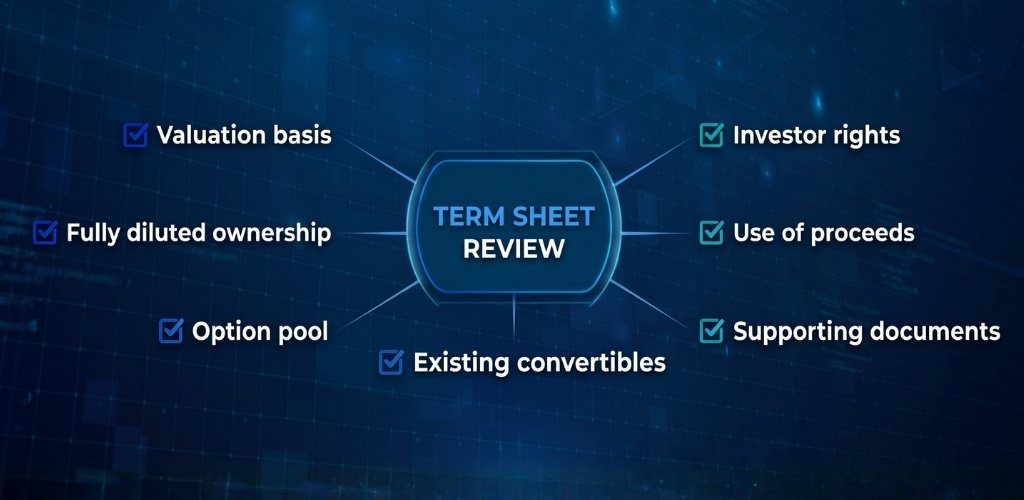
Treat the term sheet as a whole proposal rather than a single number. Go through these seven points before you accept a valuation:
Valuation basis. Is the quoted figure pre-money or post-money? Is all of the money new primary capital, or are some existing shares being sold as part of the deal?
Fully diluted ownership. Which shares, options, warrants and convertible securities are counted?
Option pool. Does the pool have to be created or enlarged before closing, and who carries that dilution?
Existing convertibles. How and at what price will SAFEs and notes convert? Do caps, discounts or interest add shares?
Investor rights. Could liquidation preferences or anti-dilution protection reduce what founders receive later?
Use of proceeds. How much money actually reaches the company, and what will it pay for?
Supporting documents. Do the cap table, financial statements, earlier financing agreements and board approvals back up the numbers?
The pre money vs post money valuation question belongs at the very top of this list, because every percentage that follows depends on it. Ask for a pro forma cap table that shows ownership before and after the round and spells out its assumptions. With that in hand, you can put offers side by side and settle open questions with your advisers before the definitive documents are drafted.
Keeping Fundraising Documents in Order with a Virtual Data Room
Once an investor is serious, the requests start: financial statements and forecasts, the cap table, earlier financing agreements, SAFEs, option records and board or shareholder approvals. A virtual data room gives these files a single, permission-controlled home that the company’s own team and the investor’s advisers can work from.
Boundeal VDR supports this stage of a round with a few practical tools:
Documents keeps financial, legal and corporate records in an organized folder structure.
Participants lets the company invite investors and advisers and set what each of them can access.
Confidentiality Agreement asks participants to accept standard or custom confidentiality terms before they start working in the project.
Watermarking places dynamic watermarks on document previews for users with view-only access.
Project Dashboard gives administrators a summary of the project’s information, documents and participants.
AI Deal Assistant helps users find their way around document content; it is not a substitute for professional valuation, financial modeling or legal advice.
A data room has no influence on what a company is worth and cannot guarantee that a round closes. What it does is keep the evidence behind the numbers organized and limit who sees it while investors do their review.
FAQ
Which number does the investor’s percentage come from?
From the post-money valuation. In a simple priced round, divide the amount invested by the post-money figure: $2 million against $10 million post-money equals 20%.
If I know the post-money valuation, how do I find the pre-money figure?
Subtract the new investment. A $10 million post-money valuation with a $2.5 million investment means the company was valued at $7.5 million pre-money.
Why can the same investment amount buy different stakes?
Because the stake depends on the investment relative to the post-money valuation. In the scenarios above, $2 million buys 25%, 20% or 16.67% depending on whether the pre-money valuation is $6 million, $8 million or $10 million.
Who carries the dilution from a larger option pool?
It depends on timing. A pool enlarged before the round and counted in the pre-money share base dilutes mainly existing holders; a pool enlarged after closing dilutes the new investor as well.
Does a post-money SAFE cap set the valuation of my next round?
No. The cap is used to calculate the SAFE’s conversion price under its own terms. The valuation of a later priced round is negotiated separately.
Is my paper stake what I will receive in a sale?
Not necessarily. The implied value of your shares at the post-money valuation is not a guaranteed payout. Exit price, liquidation preferences, other investor rights and transaction costs determine actual proceeds.
What should I ask for before comparing two term sheets?
A fully diluted, pro forma cap table for each offer, built on the same assumptions about the option pool and outstanding convertibles. Without it, the percentages are not comparable.
Conclusion
The pre-money figure tells you what the business is worth going into a round, and the post-money figure tells you what it is worth with the new money included. The investor’s stake, the share price and the founders’ dilution all follow from that distinction. Build the fully diluted cap table, include the option pool and any converting instruments, read the investor rights carefully, and keep the documents behind those numbers in a controlled workspace so that diligence moves without surprises.