Key Takeaways
A term sheet outlines a financing: the money, governance and investor rights that the full legal documents will later set out.
Founder ownership depends on the valuation, the option pool and converting SAFEs or notes, not only on the cheque size.
Preference and participation terms decide how sale proceeds are split, even when ownership percentages look identical.
Board seats and veto rights can give investors control well beyond their shareholding.
Confidentiality, exclusivity and cost clauses can bind both sides from the moment of signing.
Model the outcomes and have counsel review binding and restrictive terms first.
Introduction
A funding offer usually arrives as a few pages that look simpler than they are. The valuation gets the attention, but the same document decides how exit money is split, who sits on the board, what needs investor consent and whether you may keep talking to other investors. Here the clauses are grouped by effect, a sample exit is worked through and the path from signing to closing is explained.
What a Term Sheet Does in a Funding Round
A term sheet records the main points of an investment before the definitive agreements are drafted: valuation, amount, security type, governance, investor rights and closing conditions. It is the usual starting point in priced seed, Series A and later rounds, unlike a SAFE or convertible note, which is itself an investment instrument.
Founders, the lead investor and their lawyers negotiate it. Commercial points are typically non-binding at this stage, while confidentiality, exclusivity or expenses may bind, depending on wording and jurisdiction.
The Clauses, Grouped by What They Affect
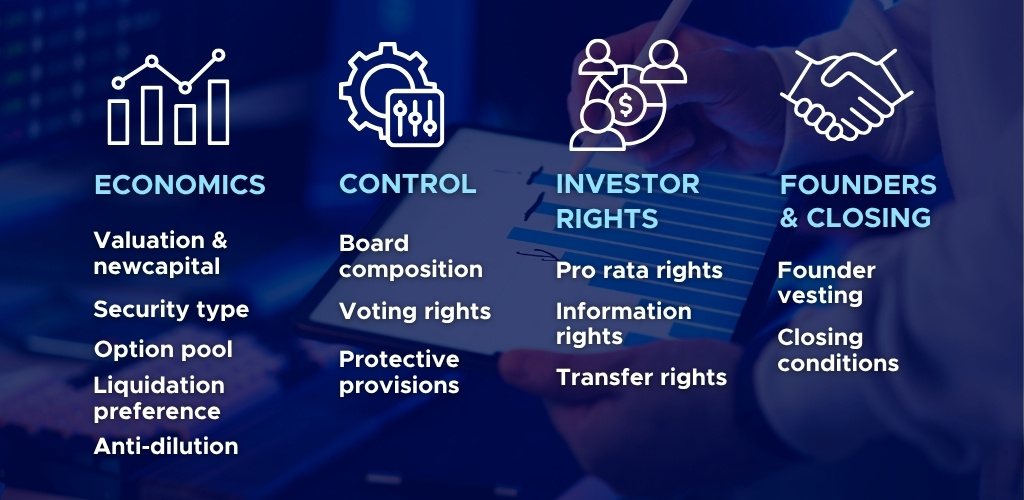
Sorting the clauses into four groups shows whether each one touches the economics of the deal or control of the company.
Economics
Valuation and new capital: the base of the ownership math. What does the fully diluted count include?
Security type: usually preferred stock. How do its rights differ from common?
Option pool: shares reserved for hires. Must it grow before closing?
Liquidation preference and participation: order and split of sale proceeds. What do founders get in a modest exit?
Anti-dilution: reprices conversion after cheaper issuances. Weighted-average or full ratchet?
Control
Board composition: who appoints directors, including the independent seat.
Voting and protective provisions: decisions requiring investor approval.
Investor rights
Pro rata and information rights: future-round participation and reporting, with their limits and deadlines.
Transfer rights: ROFR, co-sale and limits on founder sales; check the exemptions.
Founders and closing
Founder vesting: may restart vesting; ask whether past service counts.
Closing conditions: approvals, documents and diligence; are they achievable?
A generous valuation will not offset every restrictive clause.
Reading the Economics: Valuation and Dilution
In a plain priced round, post-money valuation is the pre-money figure plus new primary investment. With an illustrative $8 million pre-money valuation and $2 million invested, the company is worth $10 million post-money; the investor holds $2 million ÷ $10 million, or 20%, and existing holders keep 80%, if nothing else changes.
Usually something does. A pre-closing pool top-up dilutes mainly existing holders, and earlier SAFEs and notes may convert at their own prices, so rely on a fully diluted cap table with every instrument in it. For the formulas and more examples, see Pre-Money vs Post-Money Valuation Explained.
Exit Proceeds: How Liquidation Preferences Work
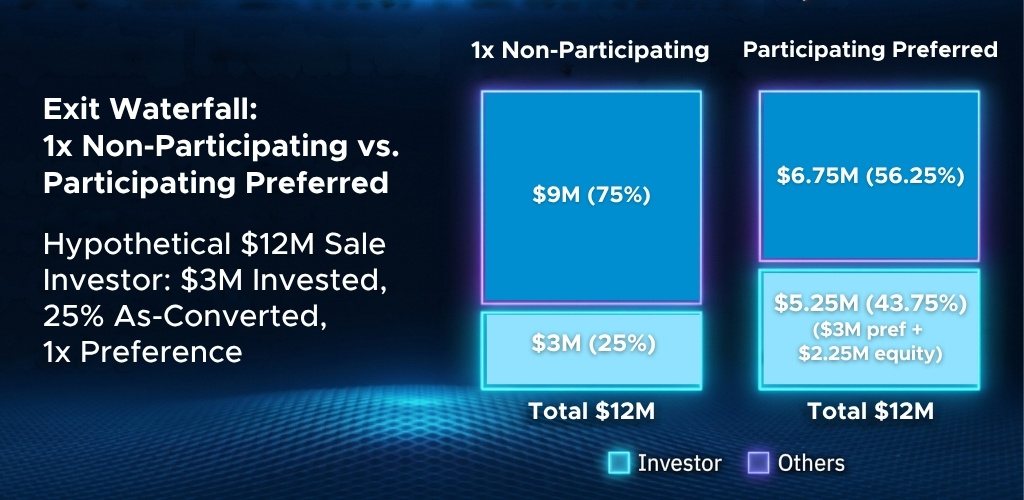
A liquidation preference lets preferred investors be paid before common shareholders in the exits the documents describe; it sets an order, not a guarantee of payment. 1x non-participating preferred generally takes the greater of its preference or its as-converted share. Participating preferred takes the preference and then shares in the rest.
Take a $12 million sale. An investor put in $3 million, holds 25% as converted and has a 1x preference; there is no debt, deal cost, other preference or participation cap.
1x non-participating: $3 million preference versus 25% of $12 million, also $3 million. The investor receives $3 million; other shareholders split $9 million.
Participating: $3 million first, then 25% of the remaining $9 million ($2.25 million), so $5.25 million in total; other shareholders split $6.75 million.
Same exit, same stake, a $2.25 million difference. With several preferred rounds, senior classes in the stack are paid first, so check seniority and participation caps.
Control: Board Composition and Investor Vetoes
New rounds often add investor directors, and quorum and deadlock rules matter as much as seat counts. A minority holder can still have real control.
Protective provisions may require preferred consent to issue senior securities, change the charter, borrow heavily, sell key assets or sell the company. Wide vetoes slow operations and later rounds, so agree clear thresholds and exceptions.
Investor Protections That Outlast the Round
Anti-dilution reprices conversion after a qualifying cheaper issuance. Broad-based weighted-average protection reflects both price and number of new shares; full ratchet resets to the lower price regardless of volume and usually hurts founders more.
Pro rata rights let qualifying investors join later rounds within notice and allocation limits, and information rights may require financial statements and budgets. Registration rights, ROFR, co-sale and transfer limits can constrain future deals, so consider how they will interact next time you raise.
Binding vs Non-Binding Provisions
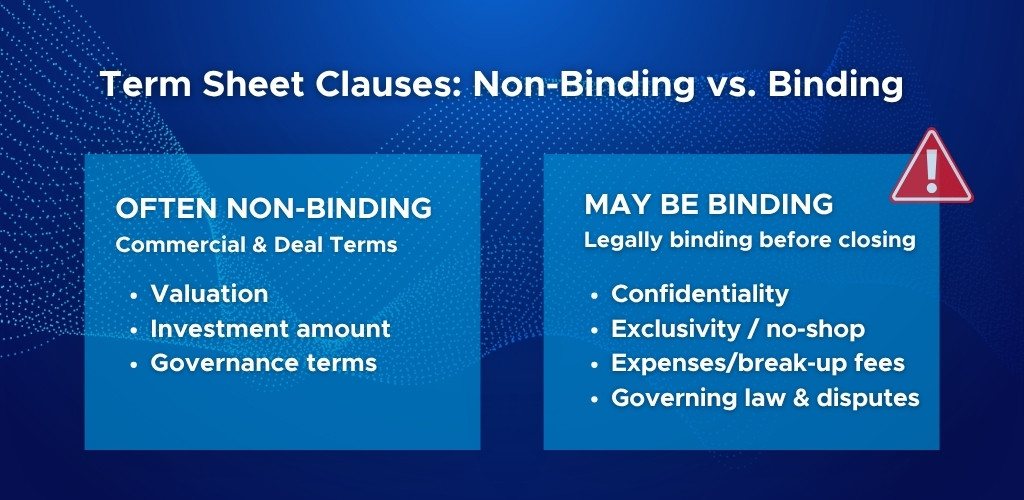
Valuation, amount and governance terms are often non-binding until the definitive documents, but some provisions may bind at once:
Confidentiality: limits disclosure of the talks and shared information.
Exclusivity or no-shop: bars talks with other investors for a set period.
Expenses or break-up fees: allocate costs or require a payment if the deal ends.
Governing law and disputes: set how these obligations are read and enforced.
A no-shop can block other offers without assuring a closing. Check its length and exceptions, and ask counsel about enforceability under local law.
Walking Through an Illustrative Term Sheet
This learning example is not a document to sign:
$2m investment: all at closing or tied to milestones?
$8m pre-money valuation: which share count and convertibles are assumed?
10% option pool post-closing: funded from the founders’ side through the pre-money count?
Series A preferred: what rights attach?
1x non-participating preference: any senior classes, and which events trigger payment?
Three board seats (common, preferred, jointly chosen independent): who approves the independent?
Pro rata rights: what limits apply?
Confidentiality and a 30-day no-shop: what binds now, and when does exclusivity end?
The figures are hypothetical; NVCA model documents are US reference forms, not mandatory templates.
From Signature to Closing
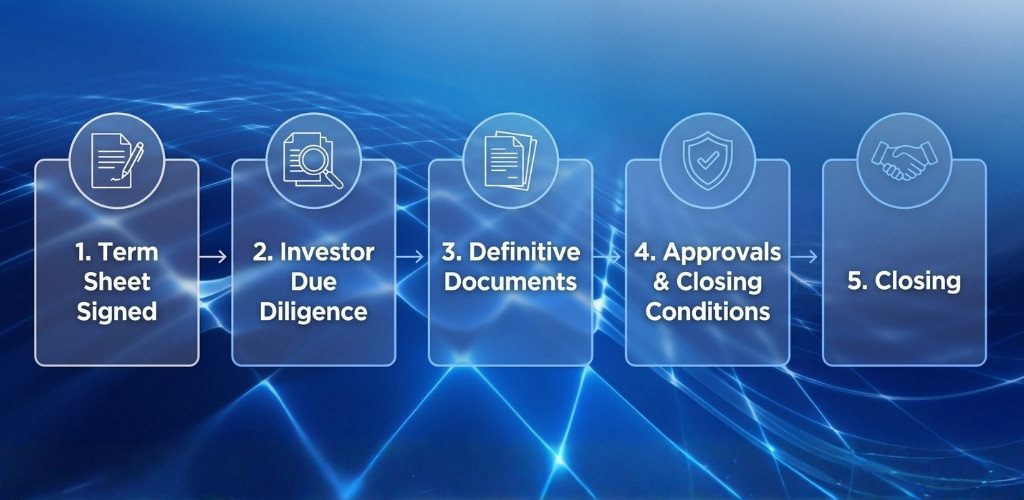
Term sheet signed: the outline is agreed and binding clauses apply.
Investor due diligence: financial statements, forecasts, cap table, approvals, material contracts, IP and tax or compliance records.
Definitive documents: in a US-style priced round, often an amended charter, stock purchase, investors’ rights and voting agreements.
Approvals and closing conditions: board and shareholder consents, remaining conditions met.
Closing: shares issued, funds transferred, cap table updated.
Timing varies, and signing does not ensure closing.
Before You Sign: A Founder’s Review List
Fully diluted cap table with new shares, pool changes and all convertibles.
Exit scenarios comparing preferences, participation and anti-dilution.
Board, veto, vesting, drag-along and transfer terms read together.
Pro rata, information rights, costs and exclusivity length.
Closing conditions and the clauses that bind now.
Open points agreed with the lead investor and counsel, ready for the definitive documents.
Where Founders Commonly Go Wrong
Chasing the headline valuation and missing pool dilution or a costly preference.
Underrating control terms that later block decisions.
Accepting a broad no-shop before the round is certain.
Treating the outline as the final deal.
Forgetting convertibles and the ownership shift when they convert.
Arriving at diligence unprepared, with inconsistent cap tables or missing approvals.
Managing Diligence and Closing Documents in a Virtual Data Room
Boundeal VDR gives diligence one controlled place: Documents for term sheet versions, financials, cap tables and approvals; Participants to decide who sees what; Confidentiality Agreement so participants accept terms before opening sensitive files; Watermarking on view-only previews; and Project Dashboard for an overview of the project. AI Deal Assistant helps users navigate materials but gives no legal approval and does not negotiate or sign. A data room supports an orderly review; it does not guarantee the investment.
FAQ
Why sign a term sheet before the full agreements?
It settles the main economic, legal and governance points so lawyers draft from an agreed framework.
Can any part of a term sheet be enforced?
Yes. Confidentiality, no-shop and expense clauses may be enforceable even when commercial terms are not, depending on wording and law.
Which clauses most affect founders’ exit proceeds?
Preference, participation and seniority; in the $12 million example, participation shifted $2.25 million to the investor.
Non-participating vs participating preferred: what is the difference?
The first takes its preference or its as-converted share, whichever is greater; the second takes its preference and then shares in the remainder.
What does a no-shop prevent?
Pursuing competing financing for the agreed period, such as 30 days, within the clause’s scope and exceptions.
What can founders negotiate?
Economics, governance and investor protections, ideally with counsel who can flag immediately binding terms.
Does a signed term sheet mean the money will arrive?
No. Funds move only after diligence, definitive documents, approvals and closing conditions.
Conclusion
A term sheet frames a priced round, and valuation is only one part of it. Model ownership and exit proceeds, weigh control and investor rights alongside the economics and know which clauses bind from day one. Sound legal review and well-organized, access-controlled documents help the deal move toward closing, though nothing guarantees it.