Key Takeaways
Under the standard Y Combinator form, a SAFE is a right to receive shares later; it carries no interest and has no date by which it must be repaid.
A convertible note starts life as a loan, so interest, a maturity date and the investor’s position as a creditor all become part of the company’s risk.
Caps and discounts give early investors more shares when they convert; with either instrument, founders still get diluted.
Post-money SAFEs and notes calculate conversion differently, which is why every outstanding instrument belongs in one model.
Standardized SAFEs often suit small pre-seed rounds, while notes tend to appear when investors want negotiated debt protections.
The final choice rests on the actual wording, what investors will accept, the governing law and how much runway the company has.
Introduction
Early on, agreeing on a share price can be harder than raising the money. SAFEs and convertible notes both let a startup take investment now and set the price at a later financing, but one is a contract for future equity and the other is debt. That difference decides who carries repayment risk, how many shares investors receive and how much flexibility founders keep.
Two Ways to Delay the Valuation Conversation
The SAFE in Plain Terms
SAFE is short for Simple Agreement for Future Equity. An investor hands over cash today and, in return, gets a contractual promise of shares when a specified event happens, usually a priced equity round. Nothing is issued at signing. In Y Combinator’s standard post-money version, the SAFE is not a loan: there is no interest and no maturity.
The commercial terms usually come from a short menu. A post-money valuation cap makes it simpler to estimate how much of the company the SAFE holders will own. A discount gives them a lower price than new investors pay in the round. A most-favored-nation (MFN) clause lets the holder take advantage of certain better terms granted later. Pro rata rights, if any, are often set out in a separate side letter. The older pre-money SAFE measures capitalization differently, and customized versions may combine terms in their own way.
Conversion generally happens in a defined equity financing. A sale of the company or its dissolution can lead to other outcomes under the contract. In none of these cases is the investor’s money guaranteed to come back, and the eventual shares will dilute the founders.
The Convertible Note in Plain Terms
A convertible note is a promissory note: the company borrows money, and the debt can turn into equity if agreed conditions are met. The amount borrowed is the principal, and interest may build up on it until the note is repaid or converts. Put simply, the note holder begins as a lender, not just as a shareholder-in-waiting.
The main terms are the interest rate (and whether it is simple or compounding), the maturity date, an optional cap or discount, and a qualified financing threshold: the minimum size of round that triggers conversion. Separate clauses deal with a change of control or a default. Not every note has a cap or a discount.
If the maturity date comes before a qualifying round, the document decides what happens next: repayment, an extension or conversion. Conversion does not happen on its own. In an insolvency, the holder may rank ahead of shareholders, depending on creditor priority, any subordination and local law, but that does not mean the note will be repaid if the company lacks assets.
Side-by-Side Comparison
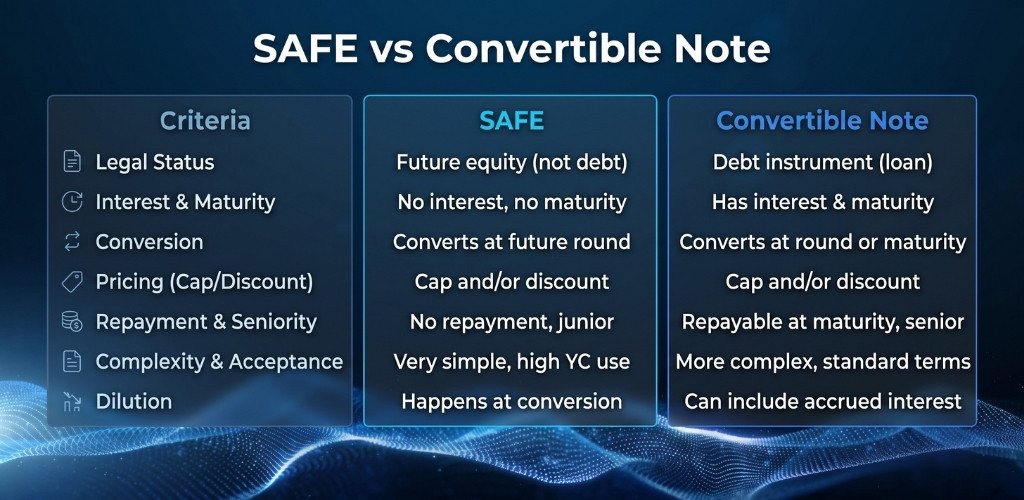
Looking at the two instruments across seven criteria makes the trade-offs clearer:
Legal status. The standard YC SAFE is a contract for future equity. A convertible note is debt and can give the holder creditor rights.
Interest and maturity. A standard SAFE has neither. A note normally sets out both.
Conversion. A standard post-money SAFE usually converts in a defined equity financing. A note may only convert in a round above a minimum size.
Pricing. Both can include a cap, a discount or both, but they calculate the conversion price under different rules.
Repayment and seniority. A note can fall due and may sit ahead of equity. A standard SAFE has no repayment date.
Complexity and acceptance. Standard SAFEs can be signed quickly; investors who want the protections of debt often ask for notes.
Dilution. A post-money SAFE makes the holders’ stake easier to see in advance. With a note, accrued interest must be added to the model.
Side letters, the option pool and other convertibles still move the final numbers; signed documents and applicable law prevail.
Caps and Discounts, Worked Through
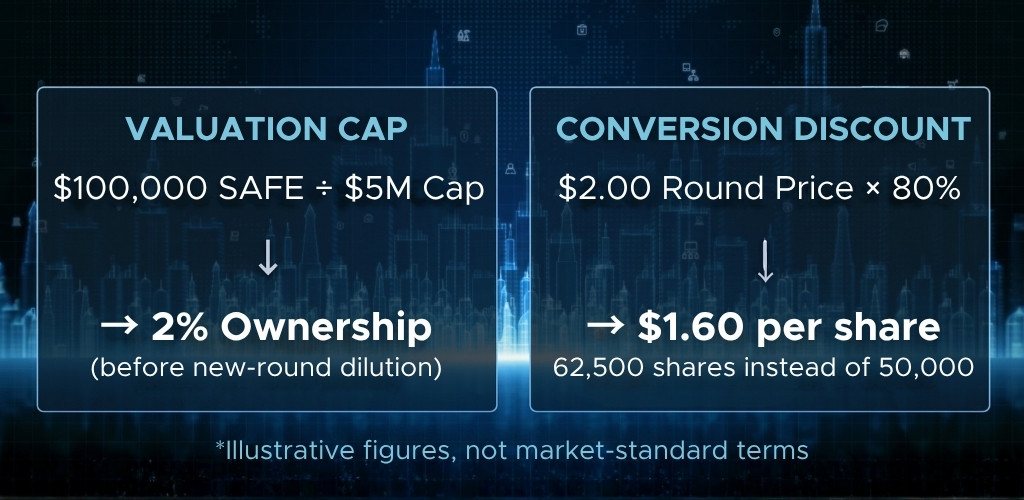
The cap and the discount are the two levers that reward early investors for taking risk, and they work in different ways. A cap sets a ceiling on the valuation used to calculate the conversion price. It is not a forecast of the next round’s valuation. A discount takes the price per share that new investors pay in the round and reduces it by an agreed percentage.
Cap example. An investor puts $100,000 into a YC-style post-money SAFE with a $5 million cap. In a simplified cap-based calculation, $100,000 ÷ $5,000,000 gives that SAFE 2% of the company, measured before the new round’s investors and any enlarged option pool dilute it. This is a percentage, not the final share count; the capitalization definition, other outstanding instruments and the terms of the round determine that.
Discount example. In a qualifying priced round, new investors pay $2.00 per share. A convertible note with a 20% discount and $100,000 to convert gets a price of $2.00 × 80% = $1.60. That buys 62,500 shares, compared with 50,000 at the full $2.00. The example leaves out accrued interest, any cap and adjustments specific to the deal; the figures show how the mechanism works and are not typical market terms.
When an instrument has both a cap and a discount, its wording says which price applies. Do not assume you can stack both reductions. Pre-money SAFEs, post-money SAFEs and notes each convert by their own formulas, so model every agreement, plus any option pool increase, before trusting a headline percentage.
What Happens at Conversion, at Maturity and at an Exit
Conversion only happens when the contract’s conditions are met. A note that requires a minimum qualified financing may stay outstanding as debt after a smaller round. The standard YC post-money SAFE, by contrast, generally converts in a defined equity financing and has no such minimum.
Interest adds shares as well as cost. Say a $100,000 note has accrued $5,000 of interest and both amounts convert at $1 per share: the holder receives 105,000 shares instead of 100,000. The note itself determines whether interest compounds, converts or must be paid in cash.
A SAFE creates no maturity pressure but may carry rights in a sale. A matured note follows its terms: repayment, amendment or conversion. Payment order and recoveries in a sale or wind-down differ between the two.
Before the next round, put every SAFE, note, option and warrant into a fully diluted cap table and look at ownership both before and after the financing.
Misconceptions Worth Clearing Up
“A SAFE is a safe investment.” The name is an acronym; investors can lose all their money.
“Signing a SAFE issues shares.” Under the standard YC form, signing creates rights; shares usually follow a defined conversion event.
“Convertible notes are all alike.” Interest, maturity, repayment, caps, discounts and thresholds vary by negotiation and template.
“Without interest there is no dilution.” A converting SAFE dilutes existing holders all the same.
Matching the Instrument to the Situation
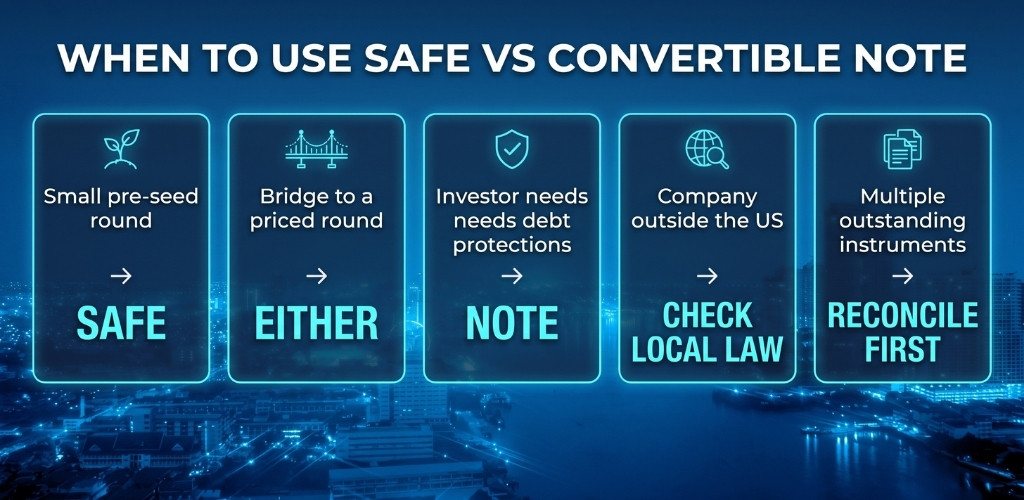
Neither instrument is better in every case. Weigh what investors will accept, the governing law, legal costs, runway and the milestone that should lead to the next round.
SAFEs suit pre-seed rounds with angels who know the standard documents and want no repayment date, though multiple caps and side letters still add dilution. Notes are common in bridge financings or when investors insist on interest and creditor protections, at the cost of a maturity date that can squeeze runway.
Five common situations and a starting point for each:
Small pre-seed round → SAFE. A standard SAFE is usually efficient if investors are comfortable with it and the conversion has been modeled.
Bridge to a planned priced round → either. Both can work; check whether a note’s maturity date fits a realistic timeline for that round.
Investor needs debt protections → note. A convertible note may be required, with its risk and cost negotiated.
Company based outside the US → check local law. Corporate, securities and tax rules may not fit a US-style YC template.
Several instruments already outstanding → reconcile first. Line up existing caps, discounts and side letters before issuing anything new.
Where enforceability or conversion terms are unclear, bring in qualified local counsel.
Warning Signs to Check Before You Sign
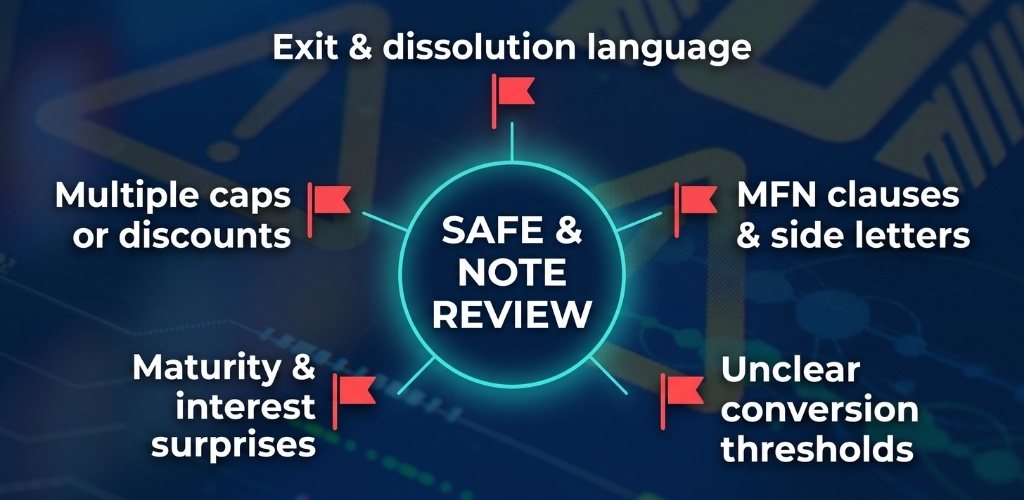
Terms that look harmless one instrument at a time can cause trouble later:
Multiple caps or discounts. Different series may convert at different prices, and a single summary cap table can hide how much dilution they add up to.
Maturity and interest surprises. Review repayment dates, default clauses, accrued interest and how extensions work before counting on a future round to solve them.
MFN clauses and side letters. Terms granted to later investors may flow back to earlier ones or create extra pro rata obligations.
Unclear conversion thresholds. A round that falls below a note’s threshold may leave the debt in place.
Exit and dissolution language. A payment formula in a contract does not mean money will be there to pay it.
Option pool assumptions. Enlarging the pool changes founder ownership and the conversion economics.
Jurisdictional fit. A familiar US template may need significant changes, or may not work at all, under another country’s law.
The common thread is to model all instruments together rather than one at a time.
The Paper Trail: Documents to Prepare at Each Stage
Before signing. The draft instrument and schedules, current cap table, earlier SAFEs and notes, side letters, investor details and agreed terms. Obtain required board and shareholder approvals and confirm signing authority.
While raising. Signed agreements and amendments, subscription and payment records, financial statements, forecasts and runway assumptions, IP and ownership documents, and a record of every extra right granted.
Before the next priced round. Reconcile principal, interest, caps, discounts, triggers and maturity terms, then build a conversion model and fully diluted cap table before and after the round and any pool change, checked against the signed documents with advisers.
Using a Virtual Data Room for SAFE and Note Records
In scattered email threads it is hard to tell which version was signed. Boundeal VDR gives these records one controlled space for investor review:
Documents holds SAFEs, notes, cap tables, financial statements and approvals in a clear folder structure.
Participants controls which investors and advisers are invited and what each of them can access.
Confidentiality Agreement requires participants to accept confidentiality terms before they see sensitive material.
Watermarking adds dynamic watermarks to previews for users with view-only access.
Project Dashboard shows administrators an overview of the project’s documents and participants.
AI Deal Assistant helps users navigate document content, but it is not legal advice and does not calculate conversions or valuations automatically.
A data room makes investor review orderly and controlled. It does not check whether the signed terms are sound, and it cannot guarantee that a financing will close.
FAQ
Is a SAFE a loan?
Not in its standard YC form: it is a right to future shares or certain proceeds, without interest or maturity. A convertible note is a loan that may convert.
When does a SAFE turn into shares?
Usually in a defined equity financing such as a priced round; a sale or dissolution can trigger other contractual outcomes.
Can a convertible note stay as debt after a funding round?
Yes, if the round misses the note’s qualified financing threshold. It then stays outstanding until it converts, is repaid or is amended.
What does a valuation cap actually limit?
The valuation used for the conversion price. The share count still depends on the SAFE version and the document’s capitalization definitions.
Can I apply both the cap and the discount?
Only if the document says so; it normally defines which price applies.
What are the options when a note reaches maturity?
Repayment, conversion or another contractual step. An extension can be negotiated but should not be assumed.
Which instrument is more common for very early rounds?
Many pre-seed rounds use SAFEs when investors accept standardized documents and the company wants to avoid a repayment date. Notes remain common where investors want debt protections. Local law, runway and a dilution model should drive the decision.
Conclusion
SAFEs and convertible notes both postpone the price question, but one is a future-equity contract and the other is debt with a deadline. Neither prevents dilution or suits every company. Weigh investor expectations, the actual terms, applicable law and runway, model all instruments together and keep documents organized; none of this replaces sound terms and professional advice.